
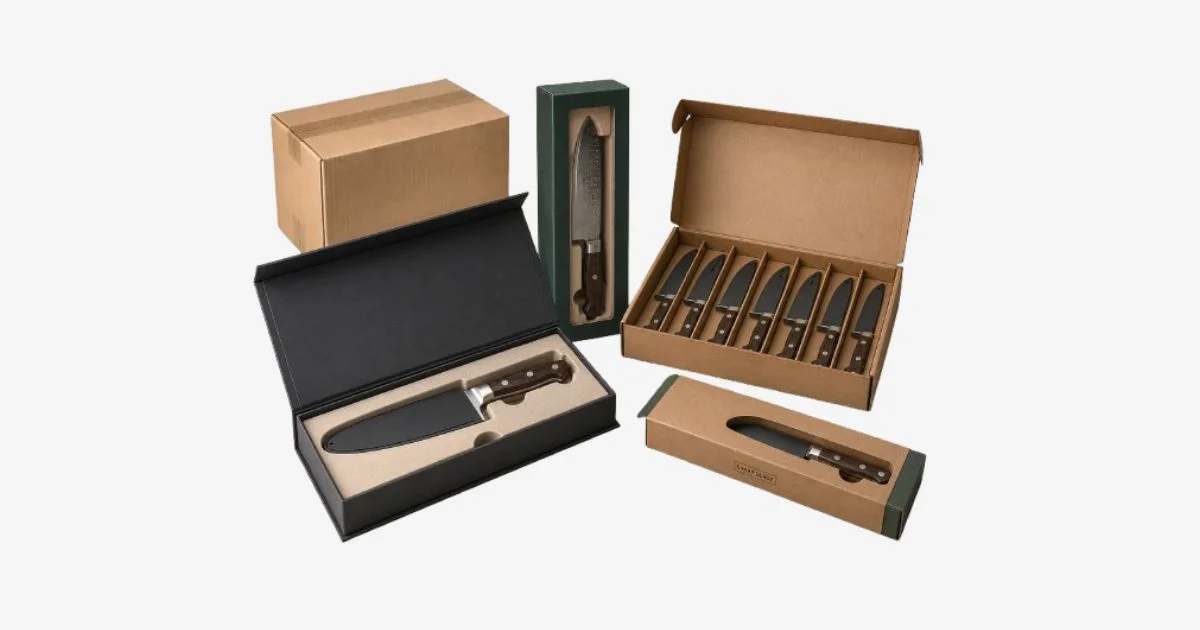
Knives need packaging that protects sharp edges, keeps every item organized and presents the product in a proper way. Boxes for knives made from paperboard can serve kitchenware companies, knife makers, gift shops, restaurants and online sellers. The right package reduces blade movement and gives customers a safer way to open, store, or display their knife collection.
A good box for knives must match the blade length, handle width and number of pieces inside. Paperboard thickness matters too. A folding carton may suit one lightweight utility knife, yet a rigid paperboard box works better for premium kitchen knives or a complete steak knife set.
Why Knife Packaging Requires Careful Planning
Blade and Edge Protection
A sharp blade can cut through thin packaging during transportation. Direct contact with paperboard can damage printed surfaces and make the package unsafe to handle. An internal holder keeps the knife in one position and limits contact between the blade and carton walls.
Knife packaging often include a paperboard insert with a shaped slot for the handle and blade. A molded pulp tray is another paper based option. It holds the product firmly and gives more support during delivery.
Handle Support
Knife handles come in wood, polymer, stainless steel and composite materials. Heavy handles can shift inside a loose box, scratching the blade or damaging the packaging corners. A storage box for knives should support both sections of the product rather than holding only the blade.
Safer Product Opening
The customer should see which side of the package opens and where the blade is located. Clear opening instructions can be printed inside the lid. Safety messages such as “Sharp Blade” and “Keep Away from Children” give buyers useful information before they lift the product.
Paperboard Materials for Boxes for Knives
Folding Paperboard Cartons
Folding cartons are suitable for small paring knives, peelers and lightweight kitchen tools. They can be printed with product details, care instructions, barcodes and company information. Tuck ends may be reinforced so the knife does not come out during handling.
Rigid Paperboard Boxes
Rigid boxes use thicker paperboard and provide a more solid structure. They are often chosen for chef knives, carving sets, collectors knives and gift packaging. A wrapped rigid box with a lift off lid can give the product an upscale appearance without using wooden packaging.
Corrugated Paperboard
Corrugated cartons work well for shipping multiple knife packages to stores, distributors or restaurant suppliers. The fluted center provide resistance against crushing and impact. Individual retail boxes may be placed inside a corrugated shipping carton with paper dividers.
Common paperboard choices include:
- Solid bleached sulfate board for clear color printing
- Kraft paperboard for a natural brown appearance
- Chipboard for rigid setup boxes
- Corrugated board for shipping and bulk orders
Shadow Boxes for Knives
Displaying Collector and Commemorative Knives
Shadow boxes for knives combine storage with presentation. They may feature a paperboard frame, deep internal space and a clear cellulose or plastic window. The knife remains visible without being handled by every customer or visitor.
These boxes are useful for collector knives, military presentation pieces, engraved gifts and limited product editions. The inner backing can carry a printed story, certificate information or the name of a collection. Dark paperboard often makes a polished steel blade more visible, though lighter colors can work for black coated knives.
Insert Design
The insert needs to follow the general outline of the knife. Paperboard tabs may hold the handle and blade, but they must not press against sharpened edge. A soft paper wrap or blade guard may be added before the item goes into its display position.
A shadow box should not be treated as a toy package. The window and frame needs enough strength to resist pressure when boxes are stacked.
Lock Box for Knives
Packaging Security and Restricted Access
A lock box for knives adds a level of access control for homes, retail counters and professional workplaces. Paperboard packaging cannot replace a steel security safe, though a rigid paperboard structure with tamper seals or a locking closure can discourage casual opening.
Retailers may use magnetic closures, tab locks, security labels or tear resistant paper tape. A lockable outer case may hold the paperboard knife box for longer storage. This arrangement gives both presentation and a more secured setup.
Tamper Evidence
A printed seal can show if someone opened the carton. Serialized labels, QR codes and lot numbers support stock tracking. These features are really useful for premium knife sales, warehouse inventory and ecommerce returns.
Box for Steak Knives
Set Organization
A box for steak knives usually holds four, six, eight or twelve pieces. Every knife should have its own slot so blades do not touch each other. Internal paperboard partitions keep spacing consistent and makes the set easier to count.
The package can include:
- Individual blade sleeves
- A fitted paperboard tray
- Printed care directions
- Dishwasher or hand washing information
- A product warranty card
The lid may show handle material, blade type and set quantity. One package might say “Six Piece Steak Knife Set,” yet another panel could use ‘6 steak knives’ for quicker reading. This small inconsistency feel normal in retail packaging but the legal product details must remain accurate.
Storage Box for Knives
Home and Professional Use
A storage box for knives serves customers who do not want a countertop block. Flat paperboard cases fit into drawers, cabinets, culinary bags and retail shelves. They may store chef knives, boning knives, bread knives and utility knives in separate compartments.
Ventilation is useful if knives are placed away shortly after washing, but all blades should be dried before storage. Moisture can weaken paperboard and may cause corrosion on some metals. A water resistant coating can protect the printed surface from minor splashes, it does not make the box fully waterproof.
Size and Fit
Measure the complete knife from blade tip to handle end. Add room for a blade sleeve and insert walls. Too much empty space permits movement, and a very tight fit make removal difficult.
Printing and Branding Options
Paperboard gives brands space for logos, product photography, safety instructions and usage information. Offset printing suits larger quantities, and digital printing can support shorter runs. Matte or gloss coatings protect artwork from light rubbing.
Foil accents, embossing and window cuts may be used for premium collections. Simple one color printing can be more affordable for wholesale or restaurant knife set. The best design is one that looks good, explains the product and keeps the knife properly placed.
Frequently Asked Questions
Can paperboard safely hold sharp knives?
Yes, with a strong insert, blade guard and suitable board thickness. A knife should never rest with its sharp edge directly against a thin carton wall.
Are shadow boxes suitable for shipping?
They can be shipped inside a corrugated outer carton with cushioning. The display window needs added protection against pressure.
Can a paperboard knife box be recycled?
Many paperboard boxes can be recycled after removing magnets, foam, plastic windows and other mixed materials. Local recycling rules may varies.
What information belongs on knife packaging?
Include knife type, blade material, quantity, care instructions, safety warnings, country of origin, barcode and manufacturer details. Good information helps the customer use and store product more safely.